
Topographico-functional Theory of Mind
by Dr. Aung Khine Phyoe of Myanmar
Published November 2024 ( Peer-reviewed version)

Introduction:
Mind is the most amazing and important thing in human’s life.
As human beings, we have capabilities to know our mind; to analyze it and it is a blessing.
Definition:
I will define mind as product of continuous consciousness.
Consciousness or wakefulness is a basic brain stem function.
To be precise, product of continuous reticulo-bulbar function.
Functions of Mind:
Mind has 3 functions:
Basic instinctive function.
Conditioning function
Analytical function
:
Mechanism
There comes arousal as brain stem reticular function continuously and thus continuous arousal sets in giving us consciousness.
1)Continuation of consciousness gives us ability to perceive our basic bodily sensations and reflexly respond to the sensations with instinctive reflexes or responses , programmed for survival. (Kind of Id-related function) (To be more clear, it is combination and continuation of brain stem function, basic perception function and instinctive reflex/response function )
Brain stem function gives us continuous consciousness
basic neurological function or basic cortical function, perception function gives us chance to perceive general/special sensory inputs and somatic/visceral motor feedback input
Instinctive reflex/response function gives us ability to express instinctive reactions/reflexes/instinctive behaviors for survival. The most basic instinctive reactions/reflex/behaviors are crying, sucking and swallowing.
2)With the help of basic cortical function which is special function of memory cortex (hippocampal function) and other basic cortical functions (temporal and parietal functions), we obtain ability to analyze perceptions. This needs very continuous and consistent mind functioning called attention and concentration which are very important to develop ability to think(mentation) which can result in learning, imitation and reproduction of behavior which constitutes conditioning behavior. (Kind of Ego-related function). Basically, we can learn to know person, place and time, which is known as orientation and situation awareness. Basically, conditioning behavior might not have full situation awareness or full orientation.
3)Development of analytical function to draw conclusions that can be delusion of sweet or bitter origin until provened otherwise. This is maturation behavior (Kind of Super Ego-related function)
Appearance of Mind
Functioning Mind has Product.
There is 1 and only 1 product of functioning Mind
It is called Behavior and we can see the behavior which is a reflection of functioning mind.
Dysfunctional mind can also be seen as behavior.
According to my theory, behavior has 3 steps. Instinctive, conditioning and maturation. (See above explanation regarding mechanism)
Behavior has 2 main components
Emotion and Motion
Emotion is a very first original and subjective feeling of a human being in response to a stressor.
Stressor can be internal or external stimulus and it can be in the form of physical or psychological in the form of thoughts or insights due to perception.
Emotion has two sub-components
Mood and Affect
Mood = first awareness of feeling on with or without insight of a perception, it is mainly described or understood by a human being as feeling good or feeling bad or neutral
Affect = first un-awared facial expression of feeling good, bad or neutral
Motion has two sub-components
Demeanor and act
Demeanor = posture of bodily parts, especially of limbs
Act = actions of bodily parts, especially of limbs, when action takes place due to mind functioning.
Thus Functioning of Mind produces Behavior
Behavior = Emotion + Motion
Behavior = Mood + Affect + Demeanor + Act
According to the steps, instinctive, conditioning and maturation, as we go from instinctive to maturation, Emotion becomes lesser in proportion where as motion becomes perfection. Thus, behavior favors survival as we mature.
Composition of Functioning Mind – Topographico-functional Theory of Mind by Dr. Aung Khine Phyoe
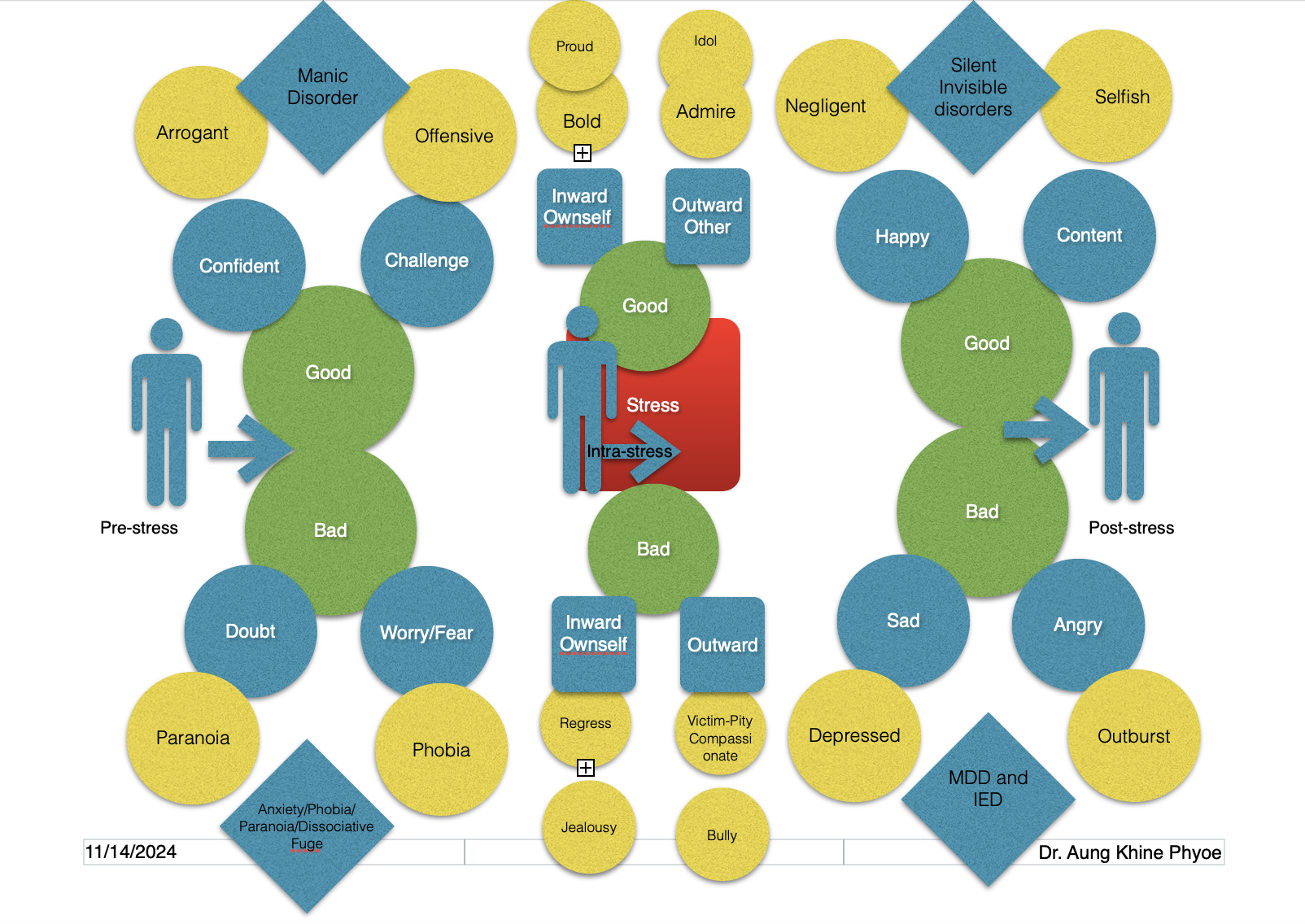
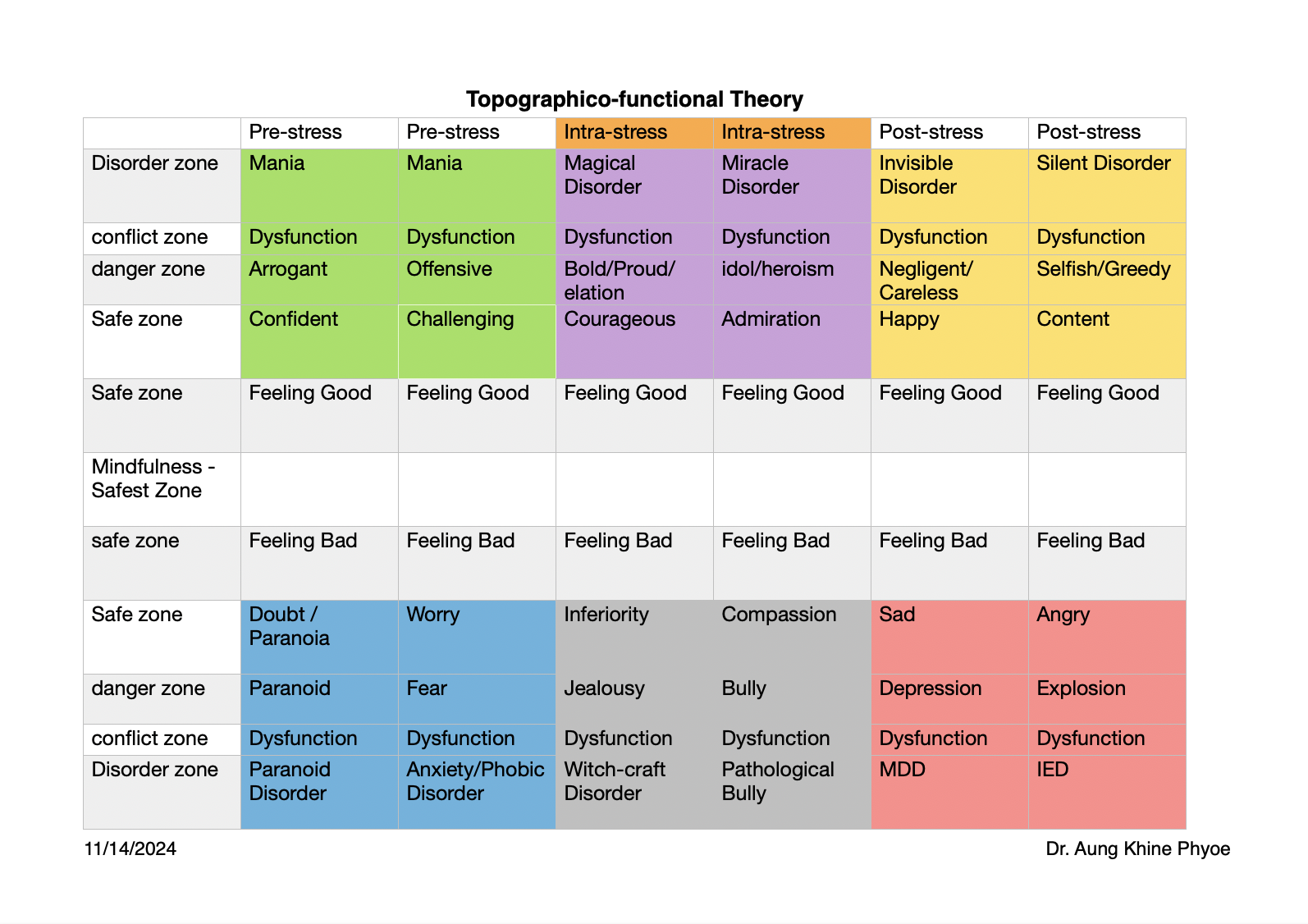
Detailed Explanation of Theory
Topographically, my theory has states and quadrants and zones.
States or States of Mind
Mind functions as it interacts with consciously, subconsciously or unconsciously with stressor or stressors.
Stressor or stressors can be physical or psychological stimuli, internal or external.
To be more specific, Stressor is conscious or unconscious or subconscious perception that is dominating the human being at the present. It could be psychological (thoughs) or physiological or physical stressor(s)
As the mind interacts with stressor or stressors, state of mind comes into existence.
.
Regarding interaction with stressor of interest, it has 3 states, namely pre-stress, intra-stress and post-stress
Pre-stress state is where human being interacts with stressor of interest.
Intra-stress sate is where human being interacting with stressor of interest
Post-stress state is where human being has finished interacting with stressor of interes
State of mind can be any where within a split second depending on how the human being reacts with stressor or stressors.
For example; People can be sad without knowing why or what is causing him or her feeling sad. Sadness is as per my theory, Post-stress state.
Quadrant
Quadrant wise, it has 6 quadrants, namely 1,2,3,4 and 5,6, by color, green, yellow, red, blue, purple and grey
Topographico-functional theory has 6 Quadrants. This will help patients to see where they are regarding their functiioning mind.
Quadrant 1 = Green
Quadrant 2 = Yellow
Quadrant 3 = Red
Quadrant 4 =,Blue
Quadrant 5 =Purple
Quadrant 6 = Grey
Quadrant 1 = Green
Quadrant 1 is where most of normal functional human beings’ functioning mind is.
All Human beings need to be in Safe Zone of Quadrant 1, which I would name normo-manic point because it is where we all should be.
The most functional secular field, as per my vision.
Quadrant 2 = Yellow
Quadrant 2 is where most of the capitalist and business people or successful human beings’ functioning mind dwells most of the time.
Important Statement by me:
Note: Quadrant 1 and Quadrant 2 disorders are not carefully addressed legally and thus, our world is in chaos.
When Quadrant 1 and 2 functioning mind goes into conflict zone, invisible crimes called invisible share and quota violations take place. Very hard to prove or make people see.
They must be addressed by early interventions before irreversible conflicts and consequences arise. Key is making the human beings see where they are and what harms they are causing to themselves and to the community.
Dr. Aung Khine Phyoe
Quadrant 3 = Red
Quadrant 3 is where most of the crimes in the world are produced by human beings. Violence towards other and Violence towards self.
This quadrant is being taken care of by legal authorities of the world but not enough because it is too late and when authority awares crimes have already taken placed.
Quadrant 4 = Blue
This is where paranoia and cowardice dwells and all the phobia and fuge disorders originate.
Quadrant 5 = Purple
Intra-stress state where you behave like “okay or wow.. so far so good.”..
Quadrant 6 = Grey
Intra-stress state where you behave like “I , you, they, we are not okay… I, you, they, we are not good”
Zones
A quadrant is made up of Zones.
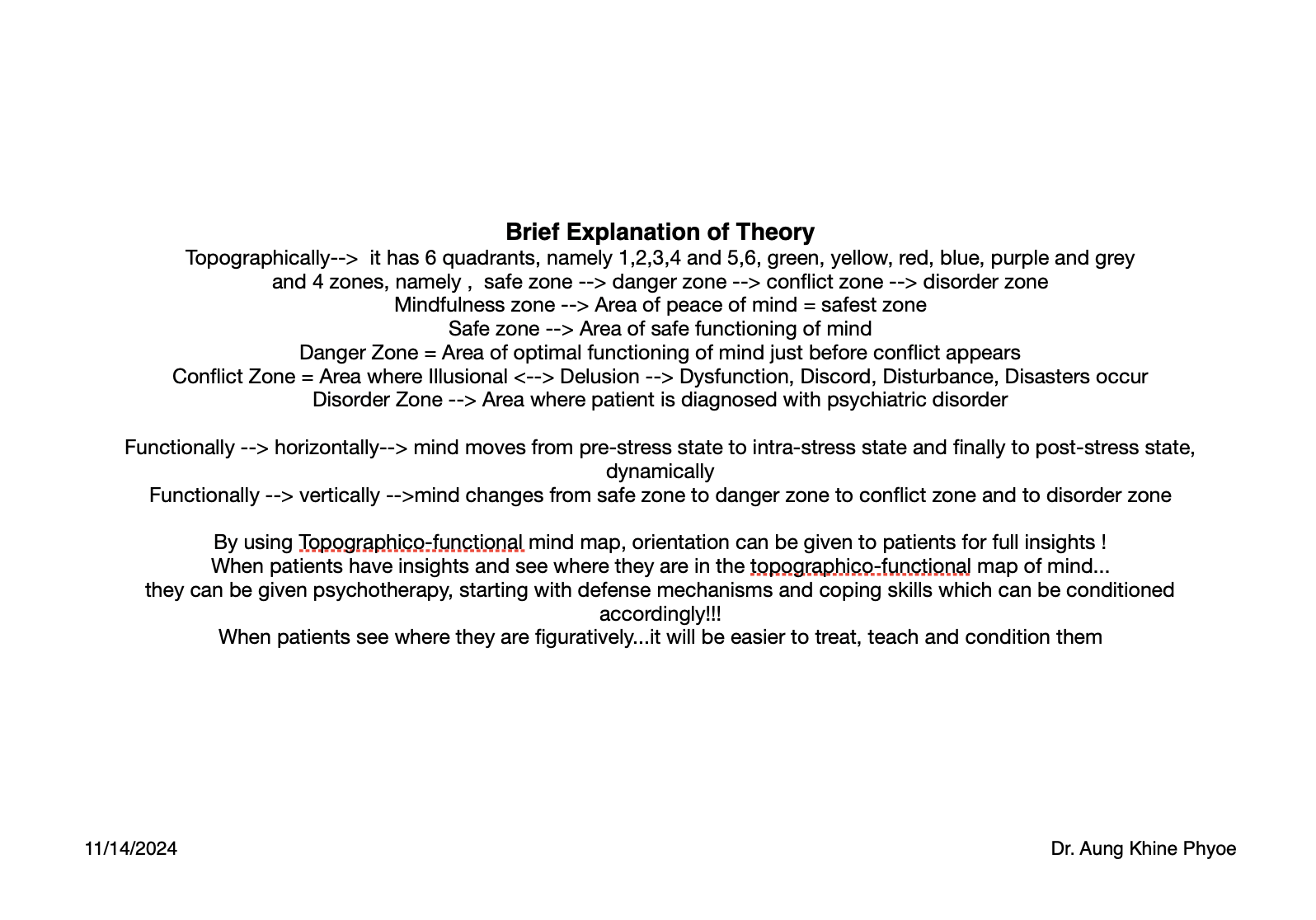
and each quadrant there are 4 zones, namely , safe zone –> danger zone –> conflict zone –> disorder zone
Mindfulness zone or I’d rather name it as Mildstillness zone –> Area of peace of mind = the safest zone
Safe zone –> Area of safe functioning of mind
Danger Zone = Area of optimal functioning of mind just before conflict appears
Conflict Zone = Area where Illusional <–> Delusion –> Dysfunction, Discord, Disturbance, Disasters occur
Disorder Zone –> Area where patient is diagnosed with psychiatric disorder
How Mind Function and change our behaviors…
Functionally –> horizontally–> mind moves from pre-stress state to intra-stress state and finally to post-stress state, dynamically
Functionally –> vertically –>mind changes from safe zone to danger zone to conflict zone and to disorder zone
Function of the mind has 3 main components: ( already described above)
Instinctive behavior
Conditioning behavior
Conscience behavior
By using Topographico-functional mind map, orientation can be given to patients for full insights !
When patients have insights and see where they are in the topographico-functional map of mind…
they can be given psychotherapy, starting with defense mechanisms and coping skills which can be conditioned accordingly!!!
When patients see where they are figuratively…it will be easier to treat, teach and condition them
Special Thanks to
Dr. Sahar Abzakh, MD, Program Director, Psychiatry Externship Program
Dr. Yohanan Preschel, MD, Attending Psychiatrist
Mr. Erik Plaza, Activity Therapist
I thank them all for all the precious experiences at the Externship . Without your kind help, I would not be able to complete and publish my my Topographico-functional theory of mind in 2024.